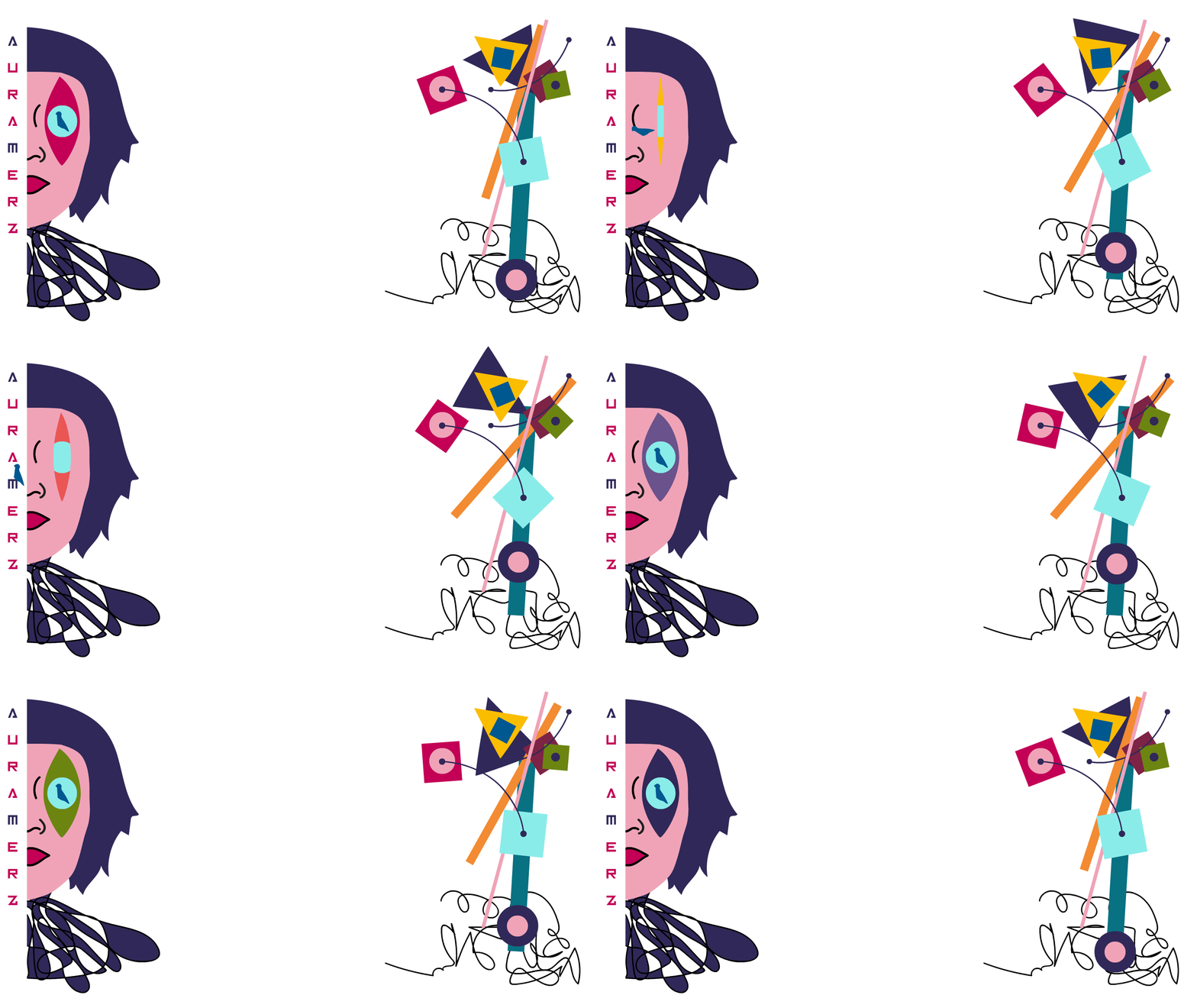
In AURA’s work, the boundary between the invisible and the visible dissolves. Ideas are not represented: they materialize. They descend onto the sensory plane as energy that assumes form, direction, and velocity.
In her practice — which traverses painting, photography, poetry, video art, music, and humor — movement is not a matter of composition, but a structural principle. Each work participates in an internal dynamic: an impulse that projects or restrains it, that causes it to expand or contract, as though consciousness were to find in matter its own mode of displacement.
“Color regulates tension; it does not illustrate, it orchestrates.”
In AURA, every creative gesture is a mental event: a form of thought that unfolds until it acquires physical density.
Her work interconnects different disciplines within a system in which each medium acts as a catalyst for the other. Painting acquires consciousness, the word becomes image, the image assumes the pulse of thought.
“AURA does not reproduce the world: she interrogates it, disassembles it, reorders it.”
What defines her work is the capacity to articulate worlds: to bind the sensible and the conceptual until they become inseparable. In AURA, the idea does not describe the body: it inhabits it. And the body does not illustrate the idea: it produces it.
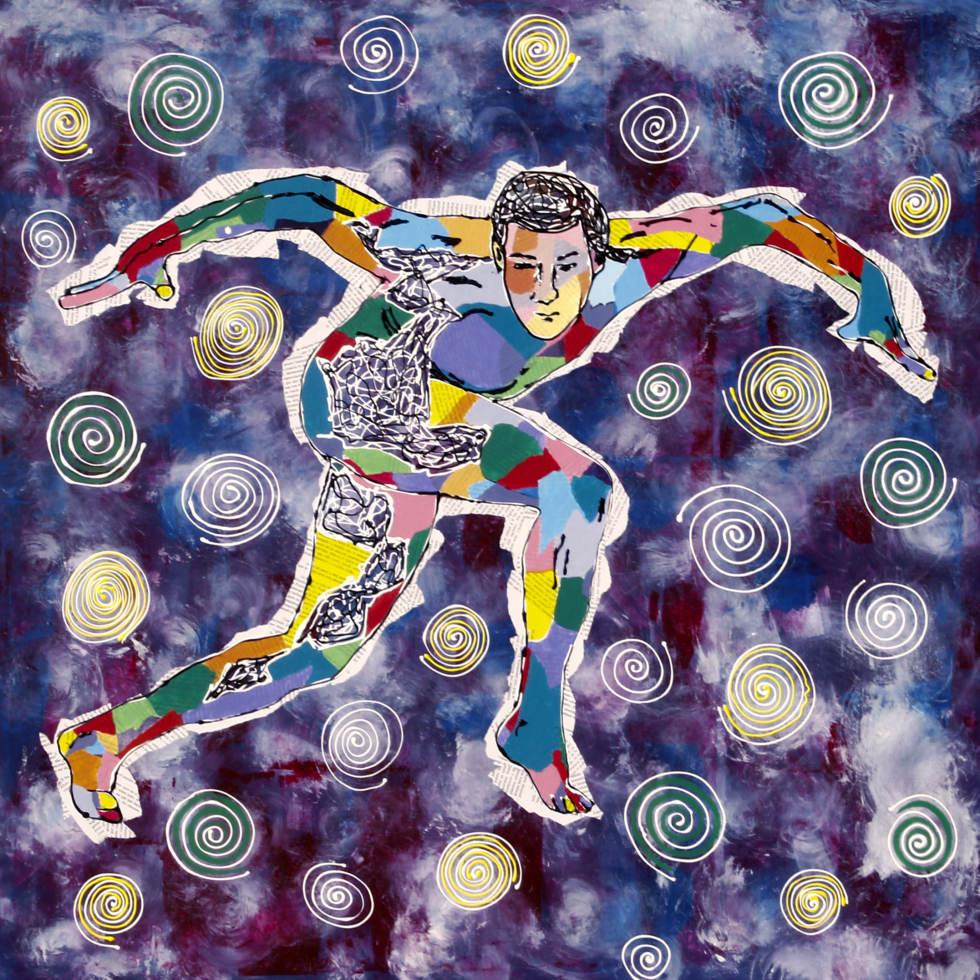
AURA’s formation does not follow an academic line, but rather a deliberate drift toward independence. She studied Professional Photography at the ARCOS Institute and Art Direction at SICA in Buenos Aires, pursued brief studies in Philosophy and Literature, but soon understood that institutional learning conditions the gaze more than it expands it.
She rejected the idea of belonging to circles, schools, or tendencies, aware that every structure tends to domesticate creative experience. For this reason, she turned isolation into method. She moved to Algarrobo, on the Poets’ Coast, between forest and sea, in order to preserve the autonomy of her gaze.
“It was not an escape, but an act of silent insurrection.”
In this retreat, AURA built a practice foreign to the urgency of being seen. Her work grew without witnesses, outside the circuit and the applause, until it acquired a self-sufficient visual grammar, capable of sustaining its own weight without intermediaries.
She is currently preparing the publication of her poetry book Humanos, edited by Silvia Denti for DivinaFollia Edizioni (Italy), a book in which poem and image do not accompany one another, but originate each other.
“In AURA, creation neither illustrates nor communicates: it thinks.”
It is the place where matter reflects and meaning is produced in the very act of making. Her work does not seek to represent reality, but to generate the spaces in which it can be thought anew.